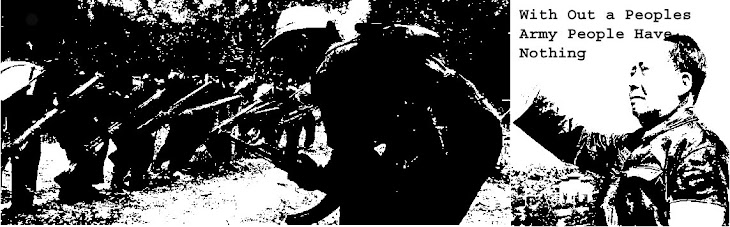
Anti-migrant backlash in Mumbai and other parts of the Maharashtra have been at the centre stage of the local, national and international media since last couple of days. Vandalism by Thackeray and Co and corresponding verbal duel amongst the political parties has been covered in its full length. Even the heightened security at the Bombay Stock Exchange (BSE) following the interrogation of six suspected Lashkar-e-Taiba (LeT) militants, who were arrested in Uttar Pradesh was also highlighted with due importance in several media. In the midst of these on going vulnerable security scenario, another potential security threat emanating from the Red guerrillas seems to have been underestimated and downplayed by media. Naxalite menace is today considered as India’s gravest security threat and to quote Prime Minister Manmohan Singh, `not a day passes without an incident of Leftist extremism taking place some place or the other’. Elaborating the alarming network of naxalites, Ajit Doval, a former Director of the Intelligence Bureau had earlier stated that Naxal activity affects approximately 40 per cent of the country\’s landmass and at least 35 per cent of the total population. Naxal violence in states like Chhattisgarh, Jharkhand, Orissa, Bihar, and Madhya Pradesh has been of late a regular affair. But what is worrying to security agencies is the penetration of rebels deep into Maharashtra.
According to media reports, eight Naxalite rebels were killed and five others seriously injured on 25 February in an encounter with the security personnel in bordering eastern district of Gadchiroli. Security personnel also recovered a huge cache of arms and ammunitions including double-barrel rifles, grenades and country-made weapons, cartridges, communication equipments from their possessions. This latest encounter is the biggest anti-naxalite operation in the recent past. In an incident of largest ever surrender of arms by rebels in the state, earlier in 12 January, 55 Maoists had surrendered to the security agencies in Gadchiroli. Prior to this, four Maoist rebels were injured in an encounter with security forces in the forest region of Kachaler in Gadchiroli. In January, security forces had seized a firearms production factory and a printing press of suspected Maoists from Ballarpur of Chandrapur district and arrested three Maoist rebels. Prior to this, on 3 January, four Maoist rebels were injured in an encounter with security forces in the forest region of Kachaler in Gadchiroli. Last year in December, rebels had blown up a mobile tower owned by a private company, followed by an encounter at Bandiya Bridge of Gadchiroli, in which two Maoist cadres were injured.
Gadchiroli along with the five eastern districts, like Chandrapur, Bhandara, Gondia, Yavatmal and Nanded are considered as worst naxal hit areas in the state. Systematic targeting of land lords, contractors, defence establishement, government infrastructure, security personnel, police informers and surrendered naxals have been common occurrences in the in the eastern regions of the state. Timber merchants, contractors, tendu leaf traders and local businessman happen to be the prime prey of Naxal extortion in those areas. There are several factors contribute to the rising red terror network in these areas. A deeper analysis of the six Naxal affected regions in the eastern part of the state indicates that all the districts fall under economically backward Vidarbha region- a legitimate ground for Naxalite consolidation in the areas. As these areas share boundry with other naxalite affected states like Andhra Pradesh, Chhattisgarh and Madhya Pradesh, infiltration gets easier. Eastern parts of the naxalite affected regions of the state shares boundary with worst red-terror hit Adilabad, Karimnagar and Nizamabad in Andhra Pradesh and Rajnandgaon, Bastar, Kanker and Dantewada in Chhattisgarh. Hence, besides the natural cover provided by the forest region and porous borders, the socio-economic backwardness in the region have provided impetus for red extremism.
However, significantly, Naxalite menace is not limited to rural forested regions of the state. Special task force constituted for anti-Naxalite operations in the state have been monitoring the increasing red terror network in some urban locations of the state following the arrest of two top Naxalite leaders in Mumbai in October 2007. Prior to this in May, a suspected Naxalite who was a resident of Bandra, was arrested from Nagpur and had revealed plans to sneak into sensitive places in Mumbai, Nashik and Pune.
According to the ministry of home affairs (MHA), seven fatalities in Naxalite violence were recorded in 2001, 29 in 2002; 31 in 2003; 15 in 2004, 27 in 2005, 49 in 2006 and 19 in 2007. However, media reports and database of various think tanks claim that actual figures of the casualties are much more than the statistics shown by the government. State security agencies might be boasting off achieving significant success in anti-Naxalite operations in the state but increasing naxalite activities over the years amplified by the reports of Union Home Ministry as well as security analysis agencies contradict the claim. Shift in Naxalite operational strategy from rural to urban areas of the state will certainly be a headache for security brass.
This `unacknowledged civil war\’ in the area in particular and other naxal affected states in general have the potential to be transformed into LTTE-kind phenomena of neighbouring Sri Lanka. Although, much has been said about combining improved policing with socio-economic measures to address grievances that instigate the naxal movement, it seems government is more concerned about policing and less about enhancing the capacity and capability of the deprived and the destitute
Subscribe to:
Post Comments (Atom)


No comments:
Post a Comment