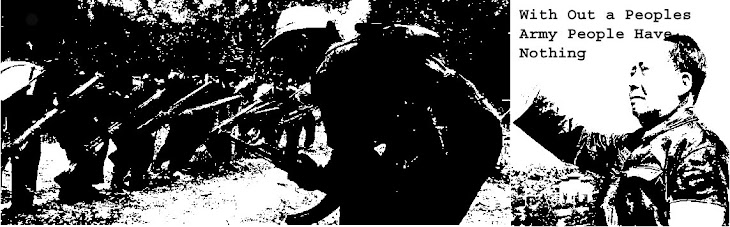
Courtesy:Tehelka
The latest Naxal attack in Orissa shows a reach that extends beyond strongholds, reports BIBHUTI PATI
 |
| Combing operations by the Special Task Force in the forests of Daspalla Photo: Bibhuti Pati |
Known for its mountainous terrain and scenic beauty, the recent Maoist attack on Nayagarh has left this Orissa town shaken. But the fact is that with virtually no police preparedness, it was a sitting target for the rebels. “There was no inkling of a Maoist attack because they did not have any base here”, told a police officer after Nayagarh’s attack. According to local vilalgers, “ They sneaked into town at different times before this attack. They were seen at various strategic places in the town.”
Although more than two weeks have passed since the attack, at the dozen operation zones in Nayagarh, Ganjam, Kandhamal and Gajapati districts, scores of security personnel are on a grim pursuit to track down the Maoists. But so far, there is no sign of the culprits, and there is a strong possibility that they now have slipped successfully into safe places.
In the state assembly, Chief Minister Naveen Patnaik said that “an intensive combing operation is on and it will continue for a long time. We have arrested many Naxals and we hope to arrest more soon. 20 of them were killed. The current operations are the biggest ever anti-Naxalite offensive in the country, backed by IAF choppers on constant watch from the sky. The police station will fortified and the vacancies filed up very soon.”
The security arrangements and preventive measures in response to such an attack on police stations in the state have always been inadequate. Going by sources contacted by TEHELKA, the attack on Nayagarh has not just exposed seriously chinks in the state’s intelligence armour, but also the government’s failure to take timely steps even though the warning bells have been ringing for some time now.
A few months back, the police learned that the Maoists were planning to target Bargarh and Nabarangpur. This information was given by an arrested Maoists leader Misir Besra, who was caught in Jharkhand in Sept. 2007. Besra’s revelations apart, police and intelligence agencies in different states had also got information and recovered material that pointed towards the Maoists Central Military Commission’s intention to conduct ‘something big’ in Orissa.
A senior IPS officer who spoke to TEHELKA says, “ We had information about Maoists movement in Daspalla area of Nayagarh district and certain other issues, but not actionable intelligence on Nayagarh.” Susanta Panda, s local journalist, said, “Movement of ultras had been reported to the police by villagers and social workers during the past two years. What does one mean by ‘actionable intelligence’ when the locals have repeatedly informed police? Even the vernacular newspapers repeatedly reported on the rebel movement spreading in Nayagarh. But the state administration turned a blind eye to this.”
After the Nayagarh incident, in an exclusive discussion with TEHELKA, Naxal leader Prithvi (name changed), said, “ The administration and police thought that we were demoralised after the arrest of some Naxal leaders in Sambalpur and of Anna Reddy (leader of CPI(ML-Janashakti) in Orissa), but we still managed to do a successful operation in Nayagarh. Some IPS officers are spreading rumours that we eat human flesh, that we are looting the poor and worst of all, that we are raping tribal girls. We proved them wrong and now the people are with us.”
The Naxalite movement is undoubtedly the most talked about internal securities issue in the country right now. It’s a conflict that has clear and deep-rooted connections with right of people over natural resources. The game plan of the Naxals from the very beginning was to earn the sympathy of the poor and operate out of hideouts in jungles and it worked wonders for them. With most tribals being too ignorant to understand ‘development’, except that they are now being denied of their rights over ‘jal-jameen-jangal’ (water-land-forests) which they have been enjoying for generations, the ultras continue to act as their saviours by enrolling them and providing them with means of survival.
Now with the tribal people already under their sway, the attack on Nayagarh looks like an attempt of the Naxals to woo the middle class, and particularly the lower middle classes, which seems to be caught between the rich and poor. Richard Mohapatra a research scholar on Naxalism says, “ it is an attempt by Naxals to spread beyond the tribal belt and venture out to non-tribal areas with a sizeable middle class population. There is no denying that it’s the crisis over livelihoods that spread Naxal activities into 16 states.”
From the siege of Koraput town in 2004 to the ransacking of the jail in R-Udayagiri in 2006, to the attack in the Anugul-Sambalpur stretch of NH42 in 2007 to the latest strike at Nayagarah each successive operation has emboldened the Maoists. The Nayagarh attacks especially were clearly intended as a statement by the Naxals that no part of the state is beyond their reach.
It’s a threat to which the state government seems clueless how to respond to. The government seems to have surrendered to the extremists who are virtually running a parallel administration in Orissa. With the chief minister holding the Home Department portfolio, there can be no shifting of the blame. But it is clear that the Orissa Police is ill-trained and ill-equipped to deal with the threat, and the center must chip in with help.
The Maoists have steadily gathered strength converting themselves from a ragtag group of rebels to a highly organised, motivated and dangerous force. The collapse of development systems in the interior, and poor health, education and growth parameters have created a fertile ground for the Naxals’s growth. At this rate their next target could well be the state capital. If there’s a lesson from Nayagarh, it’s that “Bhubaneshwar ab door nahin”. Bhubaneswar’s not far away.


No comments:
Post a Comment