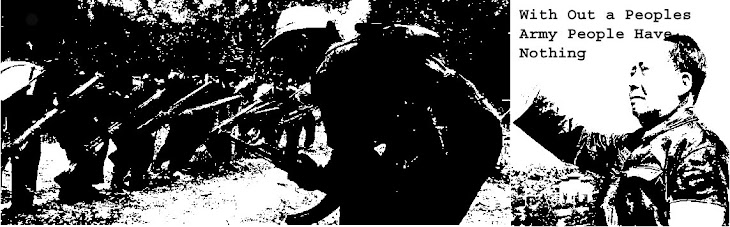
"The government should immediately launch a massive capacity-building campaign … and provide them ultra-modern weaponry to counter fast-growing Maoist violence in the country," said Ajai Sahani, executive director of the Institute of Conflict Management, a non-governmental think tank.
Sahani said most police stations, camps of paramilitary forces and armories in the Maoist insurgency-hit states are not fortified, making them vulnerable to attacks.
A status report from India's Interior Ministry admitted that barring Andhra Pradesh state, security forces in other states where Maoist guerrillas are active are simply not equipped to deal with the attacks.
The attack by rebels Feb. 15 on a police station in Nayagarh town, near Orissa state's capital, Bhubaneswar, suggests rebels are advancing toward the state's heartland and catching the state Intelligence Department unaware.
The activities of Maoist insurgents in Orissa have expanded to the central and coastal parts of the state. Earlier they were confined to a few districts in the southern region, which borders Andhra Pradesh and Chhattisgarh states.
Accounting for 27 percent of the total fatalities in India last year, left-wing extremism constitutes the biggest security threat to the country.
"Left-wing extremism has emerged as the single-biggest internal-security challenge confronting the country," Indian Prime Minister Manmohan Singh said recently.
Maoists, or Naxals as they are called in India, exercise dominance over a large part of the country's territory and carry out attacks on security forces and symbols of governance at will. Chhattisgarh has now emerged as one of the principal centers of a coordinated Maoist movement. With 361 fatalities in the past year, Chhattisgarh is the most violent state after Jammu & Kashmir.
Earlier this year the federal government dispatched specially trained paramilitary forces to combat the rebellion in Chhattisgarh and Jharkhand states.
"After reviewing the security situation in Maoist-hit states, particularly in Jharkhand and Chhattisgarh, we have decided to send five companies of trained paramilitary forces to these two states immediately to begin to combat the growing violence," said Junior Interior Minister Sriprakash Jaiswal.
Each company has 600 people.
Chhattisgarh already has 13 companies deployed in the state, the maximum in any Maoist-affected region.
Official Interior Ministry figures suggest Jharkhand and Chhattisgarh accounted for nearly 68 percent of incidents in Maoist violence and more than 75 percent of the total casualties in Naxalite violence last year.
"While the number of Maoist-affected states in the country is currently pegged at 14, the movement has demonstrated the intent and potential to spread across the length and breadth of the country," said A.B. Mahapatra, director of the Center for Asian Strategic Studies.
The Maoist threat has now overtaken all other insurgencies in the country. Maoist mobilization and violence has affected at least 165 districts in 14 states. Over the past years, while fatalities in various other insurgencies have tended to decline, fatalities related to the Maoist conflict have increased.
In India, the threat of Maoist violence is not limited to the areas of immediate operation, nor does this threat vanish if violence is not manifested at a particular location for a specific period of time. It is in the complex processes of political activity, mass mobilization, arms training and military consolidation that the Maoist potential has to be estimated, said Sahani, the insurgency expert.
Andhra Pradesh is the only Maoist-hit state where the government has been able to contain the guerrillas to a large extent with the modernization of its police and security forces and formation of elite Greyhound group

No comments:
Post a Comment