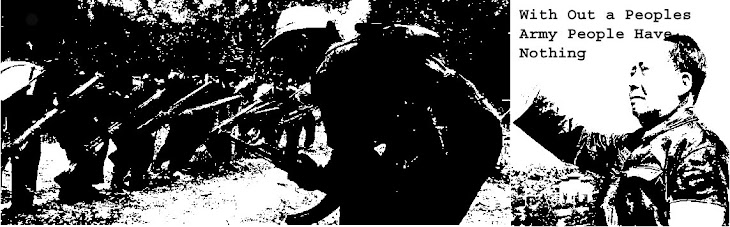
MANILA, Philippines -- Declaring his final mission is to defeat the communist insurgency, Armed Forces Chief of Staff Gen. Hermogenes Esperon Jr. Sunday said his last months in office “could be bloody” because the rebels would certainly fight back.
Esperon’s statement followed renewed peace overtures from the communist-led National Democratic Front of the Philippines (NDFP), which said it was willing to hold informal exploratory talks with the Arroyo administration to revive the peace negotiations that have been stalled since 2004.
The NDFP proposed that the exploratory talks be held in Oslo, Norway.
“The insurgency problem has always been a bloody one. With 5,700 NPAs left to defeat and who would fight back, there will be necessary violence,” Esperon said in a phone interview, referring to the New People’s Army (NPA), the armed wing of the Communist Party of the Philippines (CPP).
Asked if the next few months until May would be bloody, Esperon replied: “It could be bloody.”
Esperon was scheduled to retire on Feb. 9 but President Gloria Macapagal-Arroyo extended his term for three months up to May 9, saying his leadership was needed to sustain the momentum of the government campaign against the 4-decade-old insurgency.
Esperon said that in the Jan. 7 AFP command conference with Ms Arroyo, “we agreed to pursue the course of action for the whole year,” referring to the avowed government target of eliminating the NPA threat by 2010.
Esperon reiterated that the military aimed to dismantle 17 of the 87 so-called guerrilla “fronts” in the first quarter of this year.
“Then we will switch to the other guerrilla fronts,” he said.
Esperon has described himself as “someone who fights the NPA all the way.”
‘No letup’
In a separate interview over radio dzBB, Esperon reiterated that the military aimed to reduce the CPP-NPA to an “inconsequential organization.”
“We’ve already seen it … They are at their lowest strength [in more than 20 years], which is why there should be no letup,” he said in Filipino.
“I take the challenge of leadership … to lead the people’s Armed Forces to defeat the NPA,” he said.
The AFP claims only 5,760 NPA fighters are left, compared to the rebels’ peak strength of more than 26,000 in the late 1980s. It says the NPA strength was reduced by 20 percent in 2007 alone, or by some 1,400 members.
Esperon credited the military’s success to the so-called master plan of stamping out internal security threats, dubbed “Bantay Laya” 1 and 2.
Bantay Laya 1 and 2 consisted of combat operations, intelligence gathering, a campaign to persuade rebels to surrender, and civil-military operations to address community needs. They succeeded the Oplan Lambat Bitag strategy of the 1990s.
The Philippine Army, headed by Lt. Gen. Alexander Yano, is set to enlist some 3,000 men for six new battalions to help the 80,000-strong Army deliver what the military claims would be the “final blow” against the CPP-NPA.
While Esperon said that Yano -- whom Ms Arroyo has designated as the next AFP chief of staff after Esperon -- might do more than he in the fight against the insurgents, his edge was that his one year and seven months as chief of staff made him knowledgeable about the “style and right force mix” needed to crush the guerrilla fronts.
Esperon said that his three-month term extension would pave the way for a smooth transition in the military leadership.
In a statement the other day from his self-imposed exile in the Netherlands, the NDFP’s chief political consultant, Jose Maria Sison, said that if the Arroyo administration really wanted to resume the peace talks, it must first comply with prior agreements and eliminate impediments that violate those agreements.
“Informal exploratory talks in Oslo can thus lead to formal peace talks,” the CPP founding chair said. The NDFP is the CPP’s political wing and the umbrella organization of underground leftist groups.
Peace negotiations broke down in 2004 in the wake of moves by the European Union and the United States to place the CPP and NPA on their lists of foreign terrorist organizations.
Obstacles to peace talks
The NDFP has accused the government of putting up 12 major obstacles to the resumption of talks. These included a demand for the rebels to cease fighting before there can be any formal talks and before there can be any substantive accord on social, economic and political reforms, it said.
The Arroyo administration in 2006 ruled out the resumption of peace talks unless the rebels agreed to an immediate ceasefire nationwide.
Such a precondition, Sison said, violated the two sides’ earlier joint declaration that no one should impose any precondition that would undermine the peace negotiations.
“It is utterly wrong for the Arroyo regime to lay aside the agenda on social, economic and political reforms and convert the peace negotiations to one of surrender and pacification at the expense of the Filipino people and revolutionary forces,” he said.
The NDFP “cannot agree to the surrender and pacification of the revolutionary forces and people under the guise of an indefinite ceasefire,” he said. With report from Inquirer Research
Monday, January 28, 2008
Subscribe to:
Post Comments (Atom)


No comments:
Post a Comment